
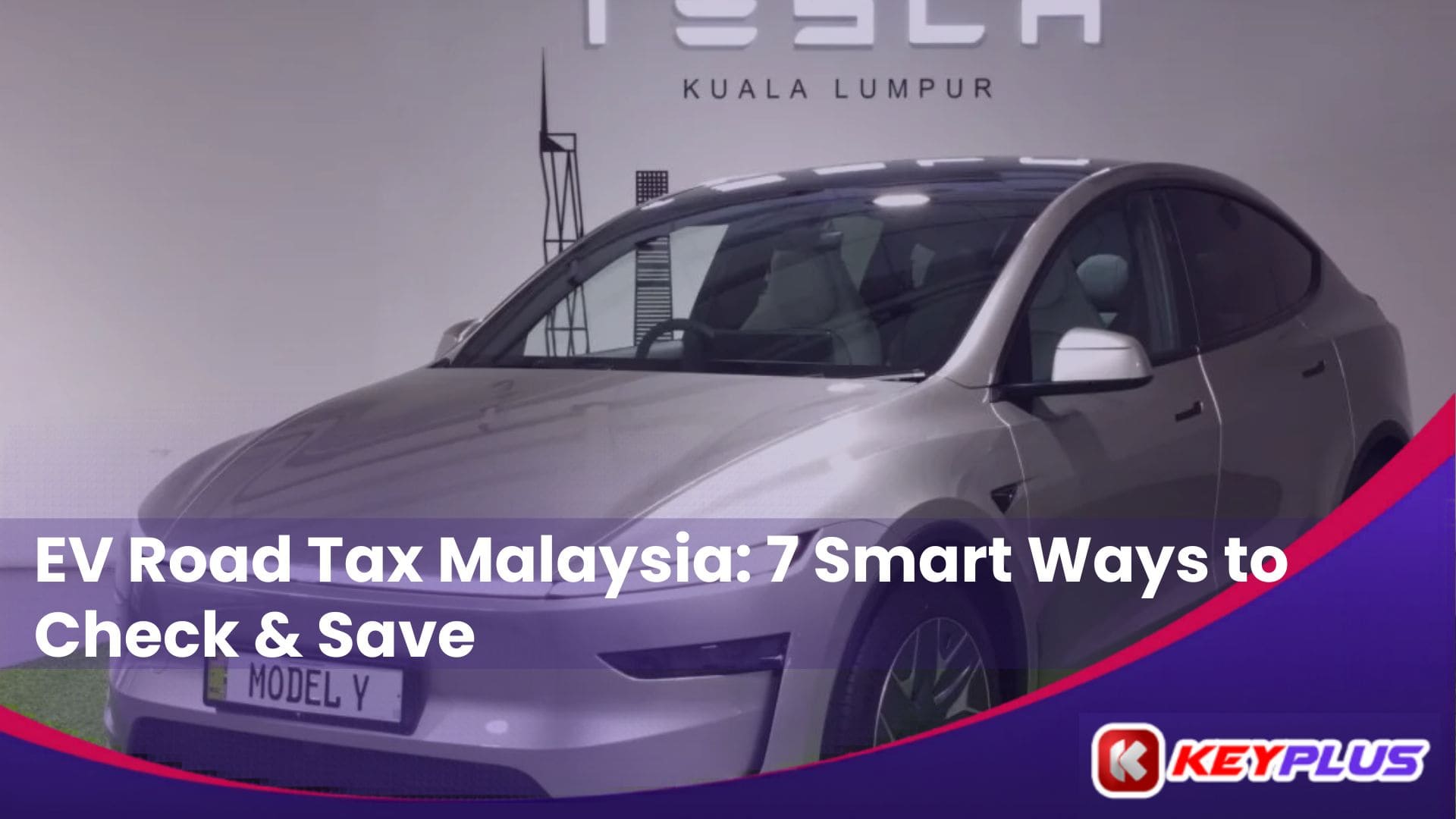
EV road tax in Malaysia is calculated by JPJ based on the electric motor’s power output in kilowatts (kW), effective 1 January 2026. The exemption that ran from 2022–2025 has ended. Rates start at RM20/year for EVs under 50 kW and go up to RM2,100+ for high-performance models above 500 kW.
Most mainstream EVs (BYD, Tesla, Hyundai, Proton) pay between RM40 and RM305 per year — up to 85% cheaper than an equivalent petrol car. You can check and renew EV road tax via the MyJPJ app, MySikap portal, or approved agents like KeyPlus.
What Changed for EV Road Tax in Malaysia?
For years, electric vehicle owners in Malaysia enjoyed a full road tax exemption — a government incentive designed to accelerate EV adoption. That exemption officially expired on 31 December 2025. Starting 1 January 2026, all Battery Electric Vehicles (BEVs) and Fuel Cell Electric Vehicles (FCEVs) registered in Malaysia are required to pay road tax annually under a brand-new framework.
The key shift: instead of being penalised under the old engine-displacement (cc) formula — which was never designed for electric motors — EVs now follow a power-based (kW) structure set by JPJ (Jabatan Pengangkutan Jalan). Transport Minister Anthony Loke confirmed in mid-2024 that the new rates would be roughly 85% lower than what EV owners would have paid under the legacy ICE formula.
⚠️ Important: Failure to renew road tax after the exemption period ended is an offence under the Road Transport Act 1987. Driving with expired road tax can result in a fine or vehicle impoundment.
💡Did you know? Under the old (pre-2022) ICE formula, an electric sedan producing 150 kW would have faced a starting road tax of over RM1,024/year. Under the new 2026 kW structure, the same vehicle pays just RM160/year.
How EV Road Tax is Calculated in Malaysia?
EV road tax is now determined entirely by the total motor power output in kilowatts (kW) — the figure printed on your Vehicle Ownership Certificate (VOC/Geran) under “Keupayaan Enjin.” For dual-motor AWD vehicles, JPJ uses the combined total kW output.
Key Formula: Find your EV’s kW rating → Match it to the appropriate Power Band (Group A–K) → Pay the fixed rate for that band. No saloon/non-saloon distinction, no private/company difference — the rate is the same for all EV owners.
What You Need to Determine Your EV Road Tax
| Information Required | Where to Find It | Example |
| Motor Power Output (kW) | Vehicle Ownership Certificate (Geran / VOC) | 150 kW |
| Vehicle Registration Number | Number plate / MyJPJ app | KEY 1234 |
| Road Tax Expiry Date | e-LKM sticker / MyJPJ app | 31 March 2026 |
| Insurance Policy Status | Insurer / insurance portal | Active & covers road tax period |
| Outstanding Summons | MySikap / JPJ portal | RM0 (clear before renewal) |
2026 EV Road Tax Rate Table — All Power Bands (Peninsular Malaysia)
JPJ groups all BEVs and FCEVs into 11 power bands (Groups A through K). The table below shows the official annual road tax rate for each group, effective 1 January 2026.
| Group | Motor Output (kW) | Annual Road Tax (RM) | Typical EV Type |
| A | 1 – 50 kW | RM20 | Budget EVs, e-bikes |
| B | 51 – 100 kW | RM40 | Entry-level city EVs (Neta V, Leapmotor T03) |
| C | 101 – 130 kW | RM100 – RM120 | Compact EVs (ORA Good Cat, MG4 Std) |
| D | 131 – 165 kW | RM160 | Mainstream EVs (BYD Dolphin ER, BYD Atto 3) |
| E | 166 – 215 kW | RM200 – RM280 | Mid-range EVs (Proton eMas 7, Hyundai Ioniq 5 RWD) |
| F | 216 – 265 kW | RM305 | Crossovers (Tesla Model Y RWD, BMW iX1) |
| G | 266 – 310 kW | RM575 | Premium SUVs (Kia EV9, Volvo XC40) |
| H | 311 – 365 kW | RM865 | Performance EVs (Tesla Model 3 LR AWD, Aion Hyper GT) |
| I | 366 – 415 kW | RM1,015 | High-performance (BMW i4 M50, BYD Seal AWD) |
| J | 416 – 465 kW | RM1,350 – RM1,640 | Sports EVs (Tesla Model 3 Performance, Audi RS e-tron GT) |
| K | 466 kW & above | RM2,100+ | Hypercars (Porsche Taycan Turbo S) |
📍 East Malaysia Note: Sabah and Sarawak road tax rates are approximately 70% lower than Peninsular Malaysia. Labuan rates are 50% of the Peninsular rate. A BYD Atto 3 that costs RM160/year in KL would cost around RM48–80/year in Sabah or Sarawak.
7 Smart Ways to Check Your EV Road Tax in Malaysia
1. MyJPJ App (Recommended)
Download the MyJPJ app (iOS/Android). Log in with your MyKad, tap “Motor Vehicle License” and select your vehicle plate. Your road tax status, expiry date, and renewal amount are shown instantly. You can also renew directly and display your e-LKM digitally — no sticker needed.
2. MySikap Portal (public.jpj.gov.my)
Visit public.jpj.gov.my and log in with your IC or Passport. MySikap shows your vehicle’s full registration record, road tax validity, and any outstanding summons. Useful if you want a browser-based check without the app.
3. Check Your Vehicle Ownership Certificate (Geran / VOC)
Your Geran lists the motor’s power output in kW under “Keupayaan Enjin.” Use this figure to cross-reference the JPJ rate table above. This is the most reliable source for your vehicle’s exact kW rating — important for dual-motor AWD models where combined output determines the band.
4. Online Road Tax Calculator Tools
Third-party calculators have been updated for 2026 EV kW rates. Enter your motor output and region to get an instant estimate. Always verify the final amount through an official JPJ channel before paying.
5. MyEG & Approved Agents
MyEG and other JPJ-approved digital agents allow you to check road tax status, renew insurance and road tax together, and receive your e-LKM sticker by courier. Convenient for owners who want a bundled renewal experience with tracking.
6. Walk-In: JPJ Branches, UTC, Post Offices
Prefer in-person? Any JPJ branch, Urban Transformation Centre (UTC), or selected post offices can check and renew your road tax. Bring your Geran, IC, and valid insurance certificate. Note: walk-in queues can be long — digital channels are significantly faster.
7. Your EV Brand’s Dealer or Service Centre
Dealers for brands like BYD, Tesla, Hyundai, and Proton can assist with road tax queries during scheduled service visits. Some dealers proactively notify customers of upcoming road tax renewals — check if your brand offers this service.
FAQs About EV Road Tax in Malaysia
Q1: Is the road tax rate different for private vs company-registered EVs?
No. Unlike petrol vehicles (where company-registered saloons pay 10% more), the 2026 EV road tax structure uses a unified rate — the annual fee is identical regardless of whether the EV is registered to a private individual or a company.
Q2: Do OKU (disabled) vehicle owners still get EV road tax exemption?
Yes. One vehicle per OKU owner remains 100% road tax exempt, consistent with the long-standing policy for ICE vehicles. This exemption applies to EVs as well, subject to JPJ verification of OKU status.
Q3: Can I renew EV road tax before it expires?
Yes. Road tax renewal can be done up to 2 months (60 days) before the expiry date. Renewing early does not shorten your coverage — the new period begins after the current one ends. This applies to all EV renewals via MyJPJ, MySikap, or approved agents.
Q4: What happens if I drive without paying EV road tax?
Driving without a valid road tax (LKM) is an offence under the Road Transport Act 1987. You risk a fine, vehicle impoundment, and issues with insurance claims if involved in an accident. JPJ enforcement includes roadblocks and mobile scanning units that can identify expired road tax in real-time.
Q5: Will EV road tax rates increase in future years?
The government has indicated the 2026 kW-based structure will be reviewed every 5 years. No rate increases have been announced at this time. The next review period would fall around 2031.
Conclusion
Malaysia’s 2026 EV road tax reform marks the end of the free-ride era — but it’s far from a setback for EV owners. By shifting from the outdated engine-displacement formula to a fairer, power-based (kW) structure, JPJ has ensured that everyday electric vehicles like the BYD Atto 3, Proton eMas 7, and Tesla Model 3 RWD remain dramatically cheaper to tax than their petrol equivalents — in many cases, by 50% to 85%.
The key takeaway for current and prospective EV owners is simple: check your motor’s kW rating on your Geran, match it to the JPJ rate table, and renew through MyJPJ or MySikap before your expiry date — ideally within the 60-day early renewal window to avoid any lapse in coverage. Whether you’re driving an entry-level city EV or a high-performance AWD model, the new structure rewards practicality without unfairly penalizing performance.
As Malaysia continues its push toward sustainable mobility, this EV road tax framework strikes a sensible balance — keeping EV ownership financially accessible for the masses while ensuring the country’s infrastructure funding remains sustainable. With rates locked in until at least 2031, now is a stable, predictable time to make the switch to electric — or simply budget confidently for the year ahead.
Always verify your exact rate via official channels — public.jpj.gov.my or the MyJPJ app — before making any renewal payment, as final amounts are determined by JPJ at the point of transaction.
More Articles to Read:
The Importance of Car Insurance In Malaysia
7 Best Car Insurance Malaysia in 2026 – Compare Prices, Quotes & Coverage